
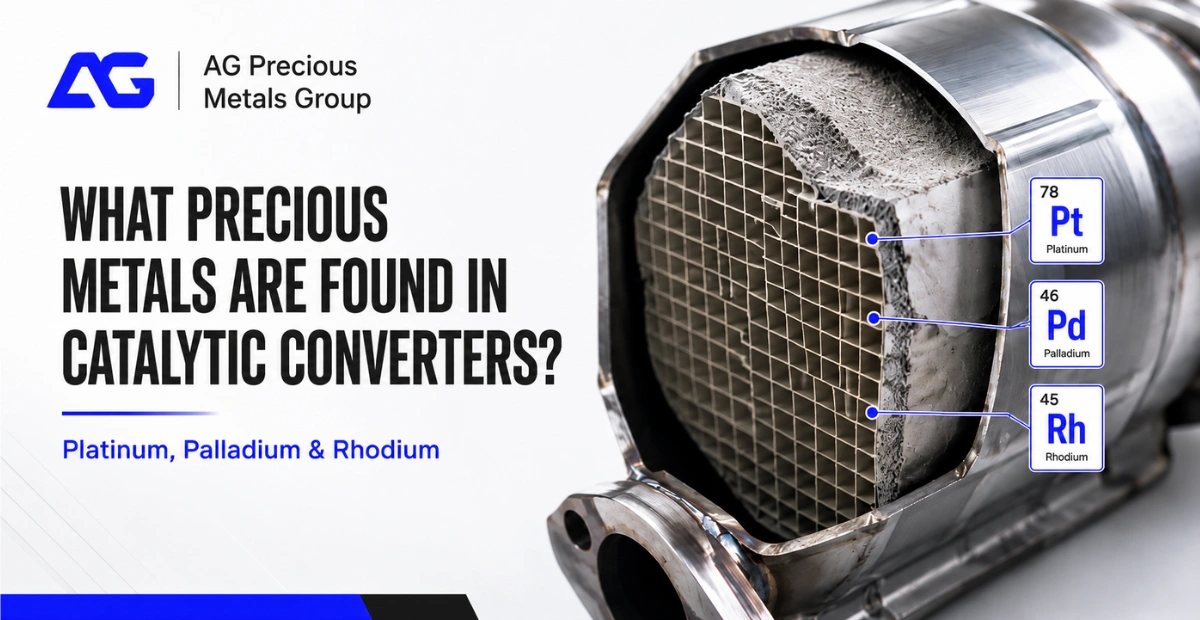
Catalytic converters are designed to reduce harmful pollutants in vehicle exhaust, but they also contain some of the world’s most important precious metals. Platinum, palladium, and rhodium are commonly used because they can support the chemical reactions required to convert harmful exhaust gases into less harmful emissions.
When a vehicle reaches the end of its useful life, the catalytic converter may still contain recoverable platinum group metals. However, the type, quantity, condition, and recoverable value of these metals can vary significantly from one converter to another.
This guide explains which precious metals are found in catalytic converters, what each metal does, why converter values differ, and how used automotive catalyst materials can be evaluated.
Why Are Precious Metals Used in Catalytic Converters?
A catalytic converter forms part of a vehicle’s exhaust system. Its purpose is to support chemical reactions that reduce pollutants produced during combustion.
The internal structure usually includes a ceramic or metallic substrate with a large surface area. This substrate is coated with a washcoat containing catalytic materials, including selected platinum group metals.
Platinum, palladium, and rhodium are suitable for this application because of their catalytic activity and ability to operate under demanding exhaust conditions. They help convert pollutants such as carbon monoxide, unburned hydrocarbons, and nitrogen oxides into less harmful substances.
The precious metals are not used as large solid pieces. They are applied in small quantities across the internal surface of the catalyst. Although the concentration may be limited, the metals can still create meaningful recovery potential when material is collected, prepared, sampled, and processed correctly.
The Three Main Precious Metals in Catalytic Converters
The most important precious metals associated with automotive catalytic converters are:
- Platinum (Pt)
- Palladium (Pd)
- Rhodium (Rh)
These metals belong to the platinum group metals, commonly referred to as PGMs. The exact combination used in a converter depends on its design, vehicle type, fuel system, emissions requirements, production period, and manufacturer specifications.
Platinum in Catalytic Converters
Platinum is one of the best-known metals used in emissions-control catalysts. It can support oxidation reactions that help convert carbon monoxide and unburned hydrocarbons into less harmful compounds.
Platinum has been used across different automotive catalyst applications and may be found in certain gasoline and diesel emissions-control systems. Its use depends on catalyst formulation, operating temperature, fuel type, and the technical requirements of the vehicle.
In recycling terms, the presence of platinum cannot be determined accurately from the external appearance of a converter. Two units that look similar may have different internal structures, metal loadings, operating histories, and remaining recoverable content.
Palladium in Catalytic Converters
Palladium is widely associated with automotive catalysts, particularly in many gasoline-engine applications. Like platinum, it supports oxidation reactions that help reduce carbon monoxide and hydrocarbon emissions.
Automotive manufacturers may use palladium alone or in combination with other platinum group metals. The selected formulation can change according to emissions standards, engine technology, catalyst design, material costs, and performance requirements.
Because formulations vary, a converter should not be valued only according to its size, weight, shell shape, or vehicle brand. Proper identification and material evaluation are necessary before reliable commercial decisions can be made.
Rhodium in Catalytic Converters
Rhodium is particularly important in three-way catalytic converters because it supports reactions that reduce nitrogen oxides. These pollutants are produced during high-temperature combustion and must be controlled as part of a vehicle’s emissions system.
Rhodium is generally used in smaller quantities than the main oxidation metals, but its contribution to catalyst performance can be significant. It is often used alongside platinum, palladium, or both.
The presence of rhodium does not mean every catalytic converter has the same commercial value. Actual recovery potential depends on the converter formulation, original metal loading, operating history, physical condition, contamination, and the effectiveness of material preparation and processing.
Does Every Catalytic Converter Contain the Same Amount of Precious Metals?
No. Precious-metal content can vary substantially between catalytic converters. There is no reliable universal value that can be applied to every converter.
Several factors can influence the type and quantity of platinum group metals present:
- Vehicle make and model
- Production year
- Engine size and configuration
- Gasoline, diesel, or hybrid powertrain
- Applicable emissions standard
- Original equipment or aftermarket production
- Catalyst substrate and internal construction
- Manufacturer formulation
- Service life and operating conditions
- Physical damage or loss of internal material
- Contamination from oil, fuel, coolant, dust, or other substances
An original equipment converter may have a different metal profile from an aftermarket replacement. A complete unit may also differ from a cut converter, loose ceramic honeycomb, crushed catalyst, or prepared catalyst powder.
For this reason, automotive catalyst materials should be classified according to their actual form before pricing, sampling, or recovery planning begins.
Common Forms of Used Automotive Catalyst Material
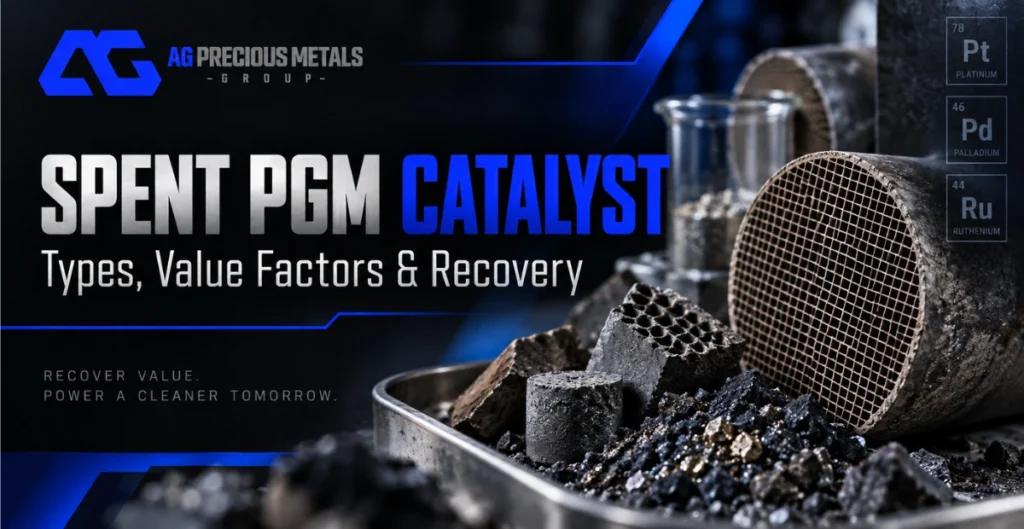
Used catalytic converter materials may enter the recycling route in several different forms:
Whole catalytic converters
These are complete converter units that still contain their outer shell and internal catalyst structure. Whole units are often reviewed according to identification details, quantity, visible condition, and available reference information.
Cut catalytic converters
Cut units have been opened or separated from part of their metal casing. Their internal ceramic or metallic catalyst material may still be present, partially present, or removed.
Ceramic honeycomb
The ceramic core may be removed from the converter shell and collected as loose honeycomb pieces. Clear separation and control are important because material loss, dust generation, and mixing can affect later evaluation.
Crushed catalyst material
Ceramic cores may be crushed to create a more uniform bulk material. Crushing alone does not establish metal content. The batch may still require correct homogenization and representative sampling.
Catalyst powder
Prepared automotive catalyst powder is generally evaluated as a bulk material rather than as individual converter units. Representative sampling becomes especially important because a small test portion must reflect the composition of the larger lot.
AG Precious Metals Group supports the review of whole converters, cut units, ceramic honeycomb, crushed material, and catalyst powder through its automotive catalyst recycling service.
What Determines the Recoverable Value of a Catalytic Converter?
The recoverable value of a catalytic converter is not determined by precious-metal market prices alone. Market prices are only one part of a broader technical and commercial evaluation.
Important factors can include:
- The actual platinum, palladium, and rhodium content
- The total quantity and net weight of catalyst-bearing material
- The physical form of the material
- The consistency of the batch
- Moisture, contamination, and non-catalyst content
- Material preparation and sampling quality
- Assay results
- Processing and recovery requirements
- Logistics and commercial terms
- Applicable metal prices and settlement conditions
This is why visual inspection should be treated as an initial review tool rather than a complete valuation method.
Why Visual Inspection Is Not Enough
A converter’s outer shell can provide useful identification information, but it does not directly show the remaining platinum, palladium, or rhodium content.
External appearance cannot reliably confirm:
- The original precious-metal loading
- Whether internal catalyst material is complete
- The level of contamination
- The consistency of a mixed batch
- The remaining recoverable metal content
- The final recovery yield
Visual review may be useful for whole units, model identification, and condition checks. However, crushed, powdered, mixed, or prepared catalyst materials generally require a more technical evaluation route.
How Is Precious-Metal Content Evaluated?
The evaluation method depends on the material form. Whole converters and prepared bulk catalyst materials should not automatically be handled in the same way.
A structured evaluation route may include the following steps:
1. Material identification
The first step is to identify whether the material consists of whole converters, cut units, loose ceramic core, crushed catalyst, powder, or a mixed lot.
2. Batch review
Quantity, source, condition, packaging, approximate weight, available photos, and previous documentation are reviewed. This information helps determine whether the material can follow a unit-based review or requires bulk sampling.
3. Material preparation
Bulk catalyst materials may require controlled crushing, milling, mixing, or homogenization. The objective is to reduce variation within the batch before a sample is collected.
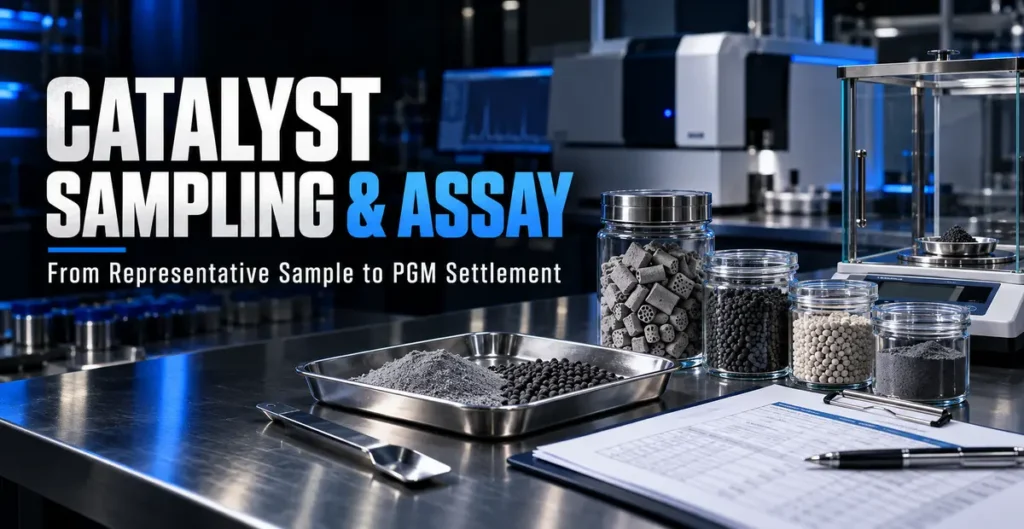
4. Representative sampling
A sample must represent the larger lot. Poor sampling can produce results that do not reflect the true composition of the material. Representative sampling is therefore one of the most important stages in bulk catalyst evaluation.
More information is available on the sampling and assay page.
5. Assay and technical evaluation
The prepared sample is analyzed to determine its metal-bearing profile. The appropriate analytical method depends on the material, preparation route, required accuracy, and commercial process.
6. Recovery and commercial planning
Once the material profile is understood, the technical and commercial route can be discussed. This may include processing requirements, recovery planning, applicable terms, and settlement structure.
AG’s broader workflow is explained on the Our Process page.
Why Representative Sampling Matters
Representative sampling is especially important when automotive catalyst material has been crushed, powdered, mixed, or prepared as a bulk lot.
A catalyst batch may not be perfectly uniform. Larger pieces, fine particles, dust, substrate material, coatings, moisture, and contaminants may be distributed unevenly. Taking a small sample from only one location can therefore produce an inaccurate result.
A suitable sampling process aims to ensure that the final laboratory portion reflects the larger batch as closely as possible. This supports clearer assay results, recovery planning, and commercial settlement discussions.
Sampling should not be treated as a minor administrative step. For many prepared materials, it is the technical foundation of the entire evaluation.
Can Precious Metals Be Recovered From Used Catalytic Converters?
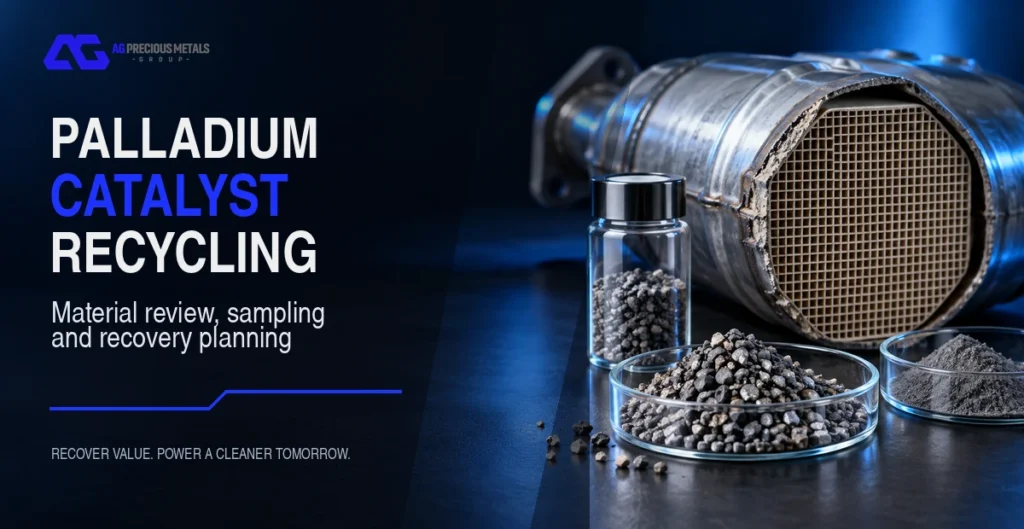
Used catalytic converters can form an important secondary source of platinum, palladium, and rhodium. Recovery allows these metals to return to industrial circulation rather than being lost through uncontrolled disposal or unsuitable handling.
The recovery route generally depends on:
- Material type and physical form
- Batch size and consistency
- Available technical information
- Sampling and assay requirements
- Contamination and preparation needs
- Selected processing route
AG Precious Metals Group provides PGM recovery solutions focused on platinum, palladium, and rhodium-bearing materials.
How Should Used Catalytic Converters Be Prepared for Evaluation?
Before contacting a recycling or recovery partner, businesses should collect clear information about the material.
Useful details include:
- Number of whole or cut converter units
- Estimated net material weight
- Material form: whole, cut, honeycomb, crushed, or powder
- Vehicle or source information, when available
- Clear photographs
- Packaging condition
- Whether the lot contains mixed materials
- Previous assay or analysis documents
- Country and location of the material
Different catalyst-bearing materials should be kept separate whenever possible. Whole converter units, loose ceramic material, metallic substrates, dust, and unrelated scrap should not be mixed without documenting the composition of the lot.
You can also review the full range of materials processed by AG Precious Metals Group.
Automotive Catalyst Evaluation With AG Precious Metals Group
AG Precious Metals Group supports businesses handling used catalytic converters and prepared automotive catalyst materials. The evaluation route is selected according to the material’s actual form, condition, quantity, and available information.
Support may include:
- Initial material review
- Whole-unit and batch information assessment
- Classification of converter material
- Sampling direction for prepared materials
- Assay coordination
- PGM recovery planning
- Commercial next-step guidance
The purpose of the initial review is to establish a clear route rather than apply one valuation method to every type of converter material.
Frequently Asked Questions
Which precious metals are commonly found in catalytic converters?
Platinum, palladium, and rhodium are the main precious metals associated with automotive catalytic converters. The exact combination and quantity depend on the converter design and application.
Does every catalytic converter contain platinum?
No. Catalyst formulations vary. Some converters may use platinum, some may rely more heavily on palladium, and others may use combinations of platinum, palladium, and rhodium.
Why is rhodium used in a catalytic converter?
Rhodium supports reactions that reduce nitrogen oxides in vehicle exhaust. It is particularly important in three-way catalytic converter systems.
Can the value of a catalytic converter be determined by weight?
Weight alone is not enough. Converter value depends on identification, internal catalyst content, metal loading, condition, contamination, material form, assay information, and commercial terms.
Are larger catalytic converters always more valuable?
No. Physical size does not directly determine precious-metal content. A smaller converter may have a different formulation or metal loading from a larger unit.
Can a damaged catalytic converter still be recycled?
Potentially, yes. However, the remaining internal material, contamination, physical losses, and batch condition must be reviewed before a suitable evaluation route can be selected.
Do crushed catalytic converters need to be sampled?
Crushed, powdered, or mixed automotive catalyst materials may require representative sampling and assay because they are evaluated as bulk materials rather than as identifiable individual units.
What information should be provided for an initial evaluation?
Provide material type, quantity, approximate weight, physical form, source information, condition, packaging details, clear photos, location, and any available assay or technical documents.
Request an Automotive Catalyst Material Review
If you have whole catalytic converters, cut units, ceramic honeycomb, crushed catalyst, or automotive catalyst powder, send the available material information to AG Precious Metals Group.
Include the quantity, approximate weight, material form, condition, source details, location, photographs, and any available analysis documents. The team will review the information and guide you toward the appropriate evaluation, sampling, assay, or recovery route.
Contact AG Precious Metals Group to request a material evaluation.
[…] You can learn more about the structure and metal types in our guide to precious metals in catalytic converters. […]