
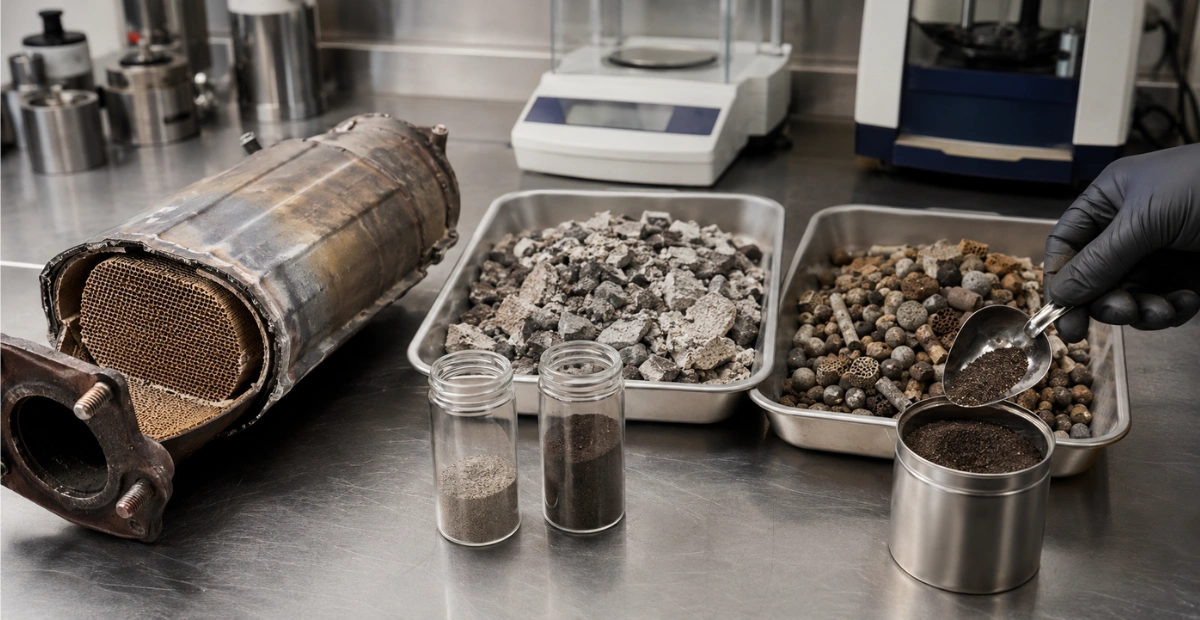
Spent catalysts are more than industrial waste. Depending on their source and application,
they may contain recoverable platinum group metals such as platinum, palladium, and rhodium.
However, identifying that potential value requires more than a visual inspection or a generic
price estimate.
The spent catalyst recycling process begins with understanding the material.
Its source, physical form, quantity, condition, consistency, and available technical information
all influence how it should be evaluated. A complete automotive catalytic converter, for example,
cannot be reviewed in the same way as catalyst powder, industrial pellets, refinery granules,
or mixed process residue.
In this guide, we explain how catalyst-bearing materials move from initial classification
through representative sampling, assay coordination, recovery planning, and the final
commercial route.
What Is Spent Catalyst Recycling?
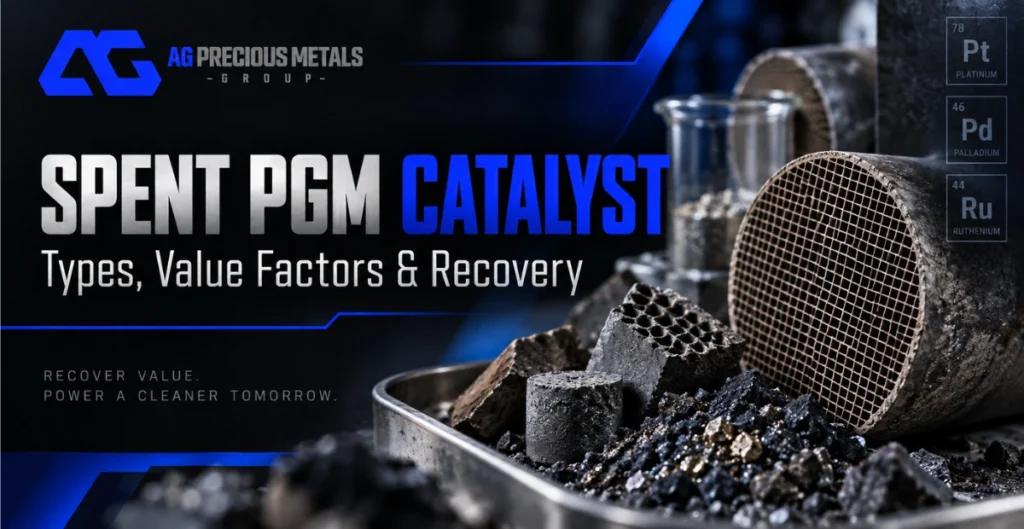
Spent catalyst recycling is the process of evaluating and directing used catalyst-bearing
materials toward a suitable recovery route. The objective is to identify valuable metal content,
reduce unnecessary disposal, and return recoverable metals to industrial circulation.
Catalysts are used in automotive emission-control systems, industrial production,
petrochemical operations, refinery process units, and many other applications. Once their
performance declines or they reach the end of their operational life, the remaining material
may still contain valuable metals.
Depending on the catalyst type, these metals may include:
- Platinum (Pt)
- Palladium (Pd)
- Rhodium (Rh)
- Gold (Au) in selected industrial and electronic materials
- Silver (Ag) in certain metal-bearing streams
- Copper (Cu) and other recoverable non-ferrous metals
The presence of a metal does not automatically determine the commercial value of a batch.
The material must first be classified, prepared where necessary, sampled representatively,
and evaluated through an appropriate technical route.
Which Catalyst Materials Can Be Evaluated for Recycling?
Catalyst-bearing materials can enter the recycling process in many different forms.
The correct evaluation method depends on both the source of the material and its current
physical condition.
Automotive catalyst materials
Automotive material may include complete used catalytic converters, cut converter units,
separated ceramic honeycomb, crushed catalyst, prepared powder, or mixed converter batches.
Whole units are commonly reviewed through quantity, unit type, visible condition, and
available identification information.
Once automotive catalyst material has been separated, crushed, or converted into powder,
a representative sampling route may become necessary. More information about this material
stream is available on our
Automotive Catalyst Recycling
page.
Industrial catalyst materials
Industrial catalysts may be supplied as pellets, beads, powders, fines, process residues,
or mixed production-related materials. Unlike automotive converter units, these materials
often require source information and process history before an evaluation route can be defined.
The previous application, physical consistency, storage conditions, contamination,
packaging, and available documentation can all affect the next step. Learn more about the
review of these materials through our
Industrial Catalyst Recycling
service.
Petrochemical and refinery catalyst materials
Petrochemical and refinery streams may include spent catalyst beds, granules, pellets,
powders, fines, and maintenance-related residues. These materials should not be treated
as general scrap because their source and operational history can be important to their
classification and handling.
Available safety data, process information, batch records, packaging details, and previous
assay reports can help create a clearer technical route. Visit our
Petrochemical & Refinery Catalyst Recycling
page for further information.
Step 1: Material Identification and Classification
The first stage of the spent catalyst recycling process is material identification.
Before discussing sampling, recovery, or commercial terms, it is necessary to understand
what the material actually is.
The initial review should include:
- Material source and previous application
- Physical form of the material
- Estimated net quantity
- Batch condition and consistency
- Packaging and storage method
- Visible contamination or foreign material
- Available photos, labels, and technical documents
- Previous sampling or assay information, if available
Clear classification helps separate automotive, industrial, petrochemical, refinery-related,
electronic, and unknown material streams. This reduces uncertainty and makes it easier to
select an appropriate evaluation route.
You can review common catalyst and metal-bearing material categories on the
Materials We Process page.
Step 2: Sorting and Material Preparation
Once the material has been identified, it may need to be separated or prepared before
technical evaluation. The required preparation depends on its physical form.
Whole catalytic converters, loose honeycomb, catalyst powder, industrial pellets,
refinery granules, and mixed residues should not be combined into one undefined batch.
Keeping different material sources and forms separated improves traceability and supports
a more reliable evaluation.
Preparation may involve confirming net weight, removing unrelated packaging,
separating foreign components, documenting moisture or contamination, and organizing
the material into clearly identified lots.
Not every material requires the same preparation. A complete converter may initially be
reviewed as a unit, while crushed catalyst, powder, fines, or mixed industrial material
may require a more controlled sampling approach.
Step 3: Representative Sampling
Representative sampling is one of the most important stages in catalyst material evaluation.
A sample is useful only when it reasonably reflects the larger batch from which it was taken.
Taking a small amount from the surface of a drum or bag may not accurately represent
the complete lot. Fine particles can settle, larger particles can separate, moisture can
vary across the batch, and mixed sources can create uneven metal distribution.
A sampling plan should consider:
- Total batch size
- Number of bags, drums, boxes, or containers
- Particle size and physical form
- Material consistency
- Moisture level
- Potential contamination
- Whether different sources have been mixed
- How the material has been prepared and stored
Crushed automotive catalyst, fine powder, industrial pellets, refinery granules,
and process residues behave differently during sampling. For this reason, the sampling
method must match the actual material rather than follow one generic procedure.
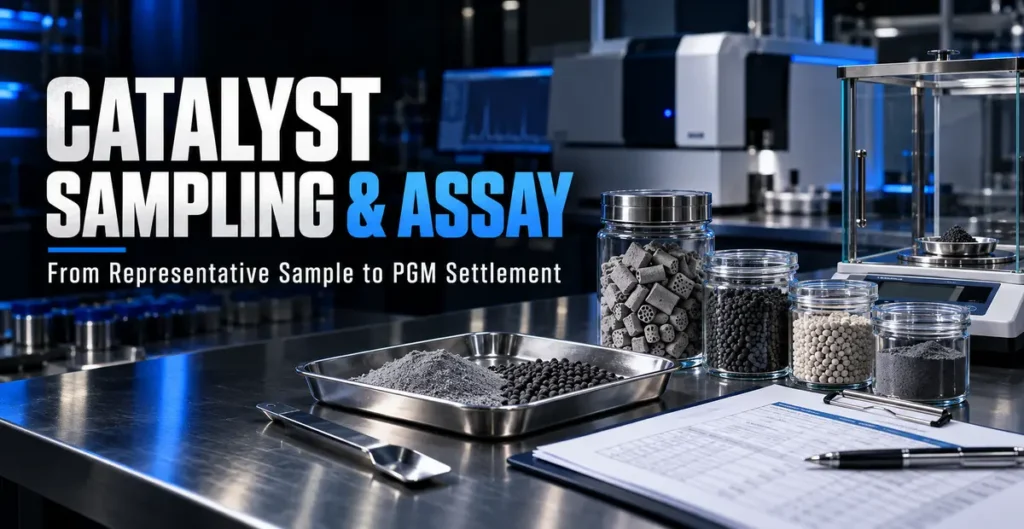
Our Sampling & Assay service
explains how representative sampling and assay coordination support clearer recovery
and commercial decisions.
Step 4: Assay and PGM Content Analysis
After a representative sample has been prepared, technical analysis can help establish
the metal profile of the material. This stage is commonly referred to as an assay.
An assay is used to determine the presence and concentration of relevant metals within
the submitted sample. For catalyst-bearing materials, the primary focus may include
platinum, palladium, and rhodium, although the required analysis depends on the material
source and expected composition.
Assay data should not be viewed separately from the sampling process. Even highly precise
laboratory analysis cannot correct a sample that does not represent the original batch.
The reliability of the commercial decision therefore depends on both sample quality
and analytical quality.
When results are reviewed, they should be considered alongside:
- The source and type of material
- The condition of the original batch
- The sampling and preparation method
- Moisture and contamination information
- Batch consistency
- The intended recovery route
Step 5: Selecting the Recovery Route
Once the material profile is clearer, the next stage is recovery planning.
The appropriate route depends on more than the name of the metal.
Automotive honeycomb, catalyst powder, industrial pellets, petrochemical granules,
and mixed process residues may require different preparation and processing routes.
The quantity and consistency of the material, available documentation, assay basis,
and commercial structure can also affect the decision.
A recovery route should be selected around the complete material profile rather than
a general assumption about platinum, palladium, or rhodium content.
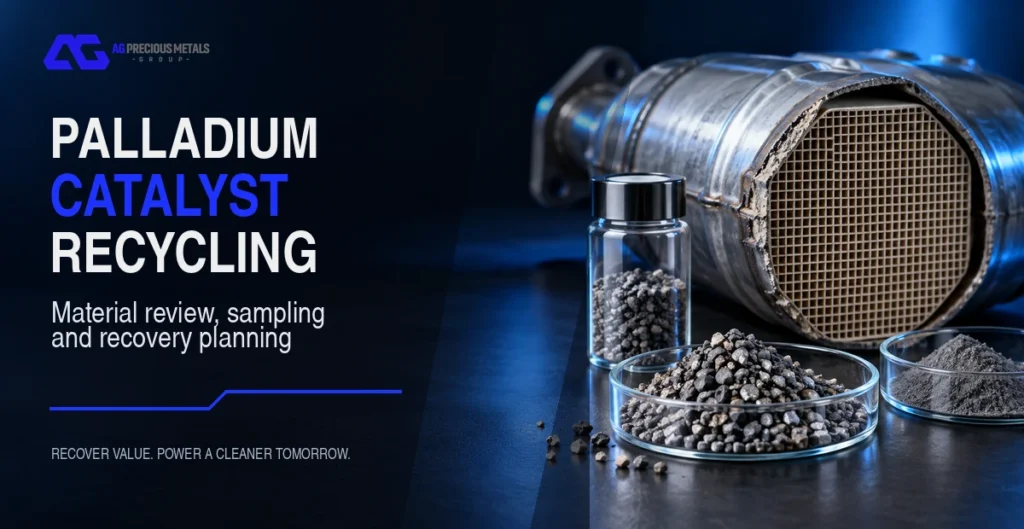
AG Precious Metals Group supports catalyst-bearing material owners with material review,
assay-informed evaluation, and
PGM Recovery planning for eligible
material streams.
Step 6: Commercial Review and Settlement
Commercial discussion should follow material identification and technical evaluation.
A reliable settlement route cannot be built around appearance or metal prices alone.
Commercial terms may be influenced by:
- Confirmed material type and quantity
- Net material weight
- Sampling and assay basis
- Identified metal content
- Material preparation requirements
- Recovery route
- Timing and logistics
- Applicable deductions and agreed payable basis
- Relevant market conditions
These elements should be reviewed clearly before the material moves forward.
The objective is to connect the technical evaluation with an understandable commercial
next step.
You can see the complete client-side workflow on our
Our Process page.
What Determines the Value of Spent Catalyst Material?
There is no universal value for a used catalyst. Two visually similar materials may have
different compositions, conditions, and commercial potential.
| Evaluation Factor | Why It Matters |
|---|---|
| Material source | Automotive, industrial, refinery, and petrochemical materials can have different metal profiles. |
| Physical form | Whole units, honeycomb, powder, pellets, granules, and residues require different review routes. |
| Batch consistency | A separated and consistent lot is generally easier to sample and evaluate than mixed material. |
| Moisture and contamination | Water, dust, packaging, dirt, and foreign material can affect net material assessment. |
| Representative sampling | The sample must provide a reasonable technical basis for evaluating the larger batch. |
| Assay results | Technical data helps establish the relevant metal content within the submitted sample. |
| Recovery route | Preparation and processing requirements can vary between different material streams. |
| Commercial terms | Timing, payable basis, deductions, logistics, and settlement structure affect the final route. |
For this reason, instant estimates based only on a photo or general material name should
be treated carefully. Photos are useful for initial classification, but detailed value
assessment may require additional material information, sampling, and assay support.
Why Representative Sampling Matters
Sampling connects the physical material with the analytical result. If the sample is not
representative, the assay may describe only the submitted portion rather than the entire batch.
This is especially important for:
- Crushed automotive catalyst
- Catalyst powders and fines
- Mixed converter batches
- Industrial catalyst pellets
- Refinery catalyst granules
- Process residues
- Materials with inconsistent particle sizes
- Wet or contaminated material
A properly planned sampling route reduces uncertainty and provides a stronger foundation
for assay interpretation, recovery planning, quotation, and settlement discussion.
Environmental Benefits of Catalyst Recycling
Catalyst recycling helps keep valuable metals in industrial circulation. Instead of treating
spent catalyst material as unmanaged waste, a controlled recovery route can identify
recoverable value and support more responsible material handling.
Platinum group metals are used in demanding industrial and automotive applications.
Directing eligible spent materials toward recovery can support resource efficiency and
reduce the unnecessary loss of valuable metal-bearing streams.
Responsible recycling starts before processing. Correct classification, stream separation,
documentation, representative sampling, and clear recovery planning all contribute to a
more controlled material route.
Learn more about our practical approach on the
Sustainability page.
What Information Should You Provide Before Requesting a Quote?
Providing clear material information can make the initial review faster and more useful.
Before submitting an inquiry, prepare the following details whenever possible:
- Material name or general description
- Industry and source of the material
- Physical form: unit, honeycomb, pellet, granule, powder, fines, or residue
- Estimated gross and net quantity
- Number and type of packages
- Current material location
- Clear photos of the material and packaging
- Information about moisture or contamination
- Safety data sheets or technical documents
- Previous assay reports, if available
- Whether different material sources have been mixed
If the exact material type is unknown, send the available information without guessing.
An initial review can help determine which details are required for the next step.
Frequently Asked Questions
Which precious metals can be recovered from spent catalysts?
Depending on the catalyst type and application, spent materials may contain platinum,
palladium, rhodium, or other recoverable metals. The actual profile must be established
from the specific material and an appropriate technical evaluation.
Can all spent catalyst materials be processed in the same way?
No. Automotive converters, industrial pellets, refinery granules, powders, fines,
and mixed residues have different physical and technical characteristics. Each stream
should be reviewed individually.
Why is representative sampling necessary?
Representative sampling helps ensure that the submitted sample reasonably reflects the
larger batch. Without a reliable sample, assay results may not provide a suitable basis
for recovery or commercial decisions.
Can catalyst value be determined from photos?
Photos can support initial identification and classification, but they usually cannot
confirm metal content or final commercial value. Additional information, sampling,
and assay may be required.
What affects the final commercial settlement?
Settlement can depend on material identity, net weight, sampling basis, assay results,
recovery route, logistics, market conditions, applicable deductions, and the agreed
commercial terms.
What should I do if I do not know the exact catalyst type?
Send the source, quantity, physical description, packaging information, and clear photos.
The material can then be reviewed to determine the appropriate classification and next step.
Start With a Clear Material Review
A successful spent catalyst recycling process starts with correct information.
Material classification, representative sampling, assay coordination, recovery planning,
and commercial review should follow a clear sequence.
AG Precious Metals Group supports automotive, industrial, petrochemical, refinery,
and other catalyst-bearing material owners with a practical route from initial inquiry
to the appropriate technical and commercial next step.
If you have spent catalyst material for evaluation, send us the material type, source,
quantity, condition, packaging details, and available photos.
Request a Quote
or
Contact Our Team
to begin the material review process.
Join the discussion