
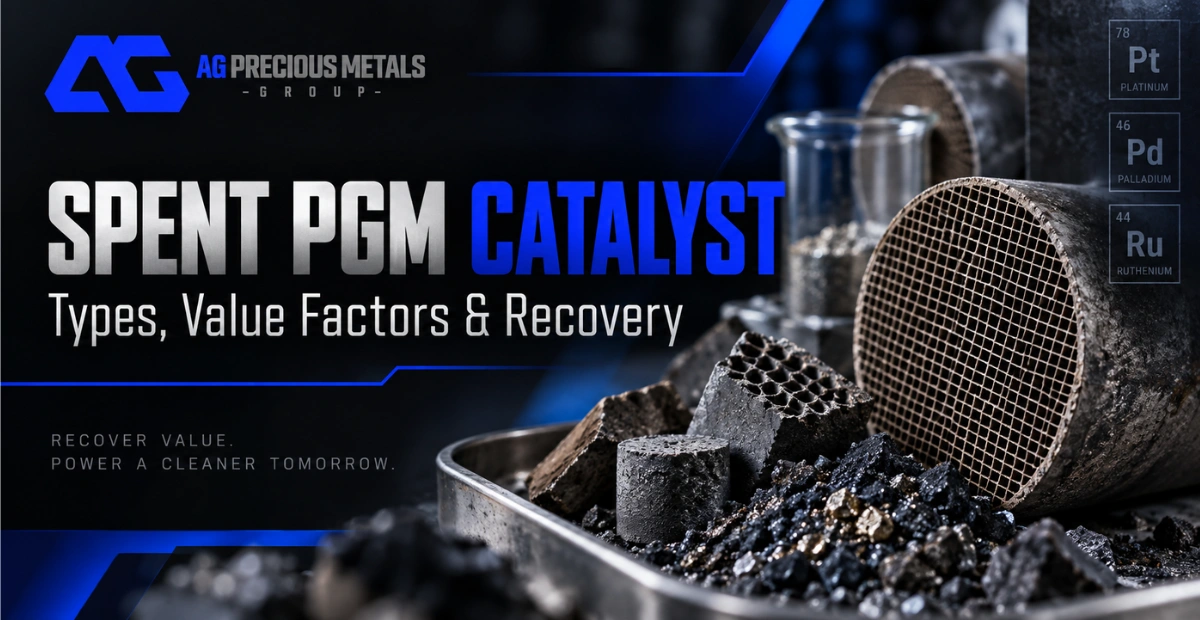
A spent PGM catalyst is a catalyst material that has reached the end of its useful operating life but may still contain recoverable platinum group metals such as platinum, palladium, or rhodium.
These materials can come from automotive emission systems, industrial processes, petrochemical operations, refineries, and other catalyst-dependent applications. Although a catalyst may no longer perform efficiently in its original process, the precious metals contained within it can still make the material commercially important.
However, the value of a PGM spent catalyst cannot be determined from its name, appearance, or total weight alone. Material source, physical form, batch consistency, contamination, representative sampling, assay results, and the selected recovery route all influence how the material should be evaluated.
This guide explains what spent PGM catalysts are, where they come from, which factors influence their potential value, and how businesses can prepare catalyst-bearing material for professional evaluation and precious metal recovery.
What Is a Spent PGM Catalyst?
PGM stands for platinum group metals, a family of precious metals used in catalytic applications because of their chemical stability and catalytic properties.
In catalyst recycling, the most commercially relevant PGMs commonly include:
- Platinum (Pt)
- Palladium (Pd)
- Rhodium (Rh)
A catalyst becomes “spent” when its performance has declined enough that it is removed from its original application. This may happen because of normal operating life, contamination, thermal degradation, process changes, replacement schedules, or other operational factors.
Spent does not necessarily mean worthless. Depending on its original formulation and condition, the remaining catalyst material may still contain precious metals suitable for recovery.
Businesses handling these materials can review AG Precious Metals Group’s catalyst and metal-bearing materials page to compare common material forms and recovery routes.
Where Do Spent PGM Catalysts Come From?
PGM-bearing catalyst materials are generated across several industries. Correctly identifying the material source is one of the first steps in determining how a batch should be evaluated.
Automotive Catalysts
Automotive catalytic converters commonly use platinum, palladium, and rhodium to support emission-control reactions.
Once removed from vehicles, automotive catalyst material may be presented as complete converters, cut units, ceramic honeycomb, metallic substrate, crushed catalyst, or prepared catalyst powder.
These material forms require different evaluation methods. Businesses handling converter streams can learn more about automotive catalyst recycling and the different routes used for whole units and prepared bulk material.
Industrial Catalyst Materials
Industrial operations may generate spent catalyst pellets, beads, powders, granules, residues, fines, or other process-related catalyst materials.
Unlike automotive converters, industrial catalyst streams often require additional information about their source, previous process application, batch history, physical condition, and available technical documentation.
AG’s industrial catalyst recycling service is designed around these source-specific material streams.
Petrochemical and Refinery Catalysts
Refinery and petrochemical operations can also generate catalyst-bearing materials after scheduled replacement, process changes, or the end of a catalyst’s operating cycle.
These materials may arrive as granules, pellets, process residues, catalyst bed material, fines, or prepared batches. The appropriate evaluation route depends heavily on the material identity and process history.
For these streams, see AG’s dedicated petrochemical and refinery catalyst recycling service.
Are All Spent Catalysts Valuable?
No. The term “spent catalyst” does not automatically mean that the material contains economically recoverable quantities of platinum group metals.
Different catalysts use different active metals and support materials. Even catalysts used for similar purposes can have different formulations.
For this reason, a material should not be valued simply because it is described as a PGM catalyst, industrial catalyst, refinery catalyst, or precious metal catalyst.
Reliable evaluation starts by identifying:
- The original material or catalyst type
- The industrial or automotive source
- The physical form of the material
- The approximate quantity
- Whether the batch is separated or mixed
- Available labels or technical documents
- Previous assay information, if available
- Visible contamination, moisture, or foreign material
What Determines the Value of a Spent PGM Catalyst?
The commercial value of a spent PGM catalyst depends on several connected factors. There is no universal price per kilogram that can accurately represent every catalyst material.
| Evaluation Factor | Why It Matters |
|---|---|
| Material source | Automotive, industrial, petrochemical, and refinery catalysts can have very different formulations. |
| PGM content | The presence and concentration of platinum, palladium, and rhodium directly affect recovery potential. |
| Physical form | Whole units, pellets, granules, powder, crushed material, residues, and fines require different review methods. |
| Batch consistency | A consistent and properly separated lot can generally be evaluated more reliably than a mixed stream. |
| Contamination | Moisture, dirt, foreign material, process residues, and packaging can affect net material assessment. |
| Sampling quality | The sample must reasonably represent the larger commercial batch. |
| Assay results | Technical analysis can establish a clearer basis for understanding relevant metal content. |
| Recovery route | Preparation and processing requirements vary between different catalyst materials. |
| Commercial terms | Settlement structure, logistics, timing, deductions, and agreed terms influence the final commercial outcome. |
Why Weight Alone Does Not Determine PGM Catalyst Value
A common mistake is to compare two spent catalyst batches only by total weight.
For example, two industrial catalyst lots of equal weight can contain different metal concentrations, support materials, contamination levels, moisture levels, and recoverable fractions. Their commercial potential may therefore be very different.
The same principle applies to crushed automotive catalyst and catalyst powder. A larger batch is not automatically more valuable on a per-kilogram basis.
For prepared or mixed materials, the question is not simply “How much material is there?” but also “What does the material actually contain, and how reliably can that content be measured?”
Why Sampling and Assay Matter for Spent PGM Catalysts
When catalyst material is crushed, powdered, mixed, pelletized, granulated, or otherwise prepared in bulk form, representative sampling becomes especially important.
Testing a small portion of material only provides useful information when that portion reasonably represents the larger batch.
An unrepresentative sample can create a distorted picture of the metal content and therefore affect both technical and commercial decisions.
Factors that may influence sampling include:
- Particle size
- Material segregation
- Batch mixing
- Moisture
- Dust and fines
- Foreign material
- Different catalyst sources within the same lot
- Packaging and storage condition
AG supports technical evaluation through representative sampling and assay coordination for catalyst-bearing materials that require a stronger evaluation basis before recovery or commercial settlement.
How Does Spent PGM Catalyst Recycling Work?
The exact route depends on the material, but professional spent PGM catalyst recycling generally begins with material identification rather than immediate processing.
A typical route may include:
- Material identification: Determine the source, catalyst type, physical form, quantity, and condition.
- Batch review: Check whether the material is separated, mixed, contaminated, prepared, or inconsistent.
- Sampling decision: Determine whether representative sampling is required.
- Assay and technical evaluation: Review relevant analytical information and the quality of the evaluation basis.
- Recovery planning: Select the appropriate technical route for the catalyst-bearing material.
- Commercial review: Connect the technical basis with quotation, processing, or settlement terms.
For a more detailed explanation of this sequence, read our guide to how spent catalyst recycling works.
How Are Platinum, Palladium and Rhodium Recovered From Spent Catalysts?
The recovery route varies according to the catalyst type, support material, physical condition, metal profile, and processing requirements.
This is why professional PGM recovery should not be treated as one generic process for every catalyst stream.
An automotive ceramic catalyst, industrial pellet, refinery granule, catalyst powder, and process residue can require different preparation and recovery strategies even when each contains platinum group metals.
The objective is to connect accurate material classification and technical evaluation with an appropriate PGM recovery route for platinum, palladium, and rhodium.
Automotive PGM Catalysts vs Industrial PGM Catalysts
Although both categories may contain valuable platinum group metals, they should not automatically be evaluated in the same way.
Automotive Material
Automotive catalyst streams may include identifiable whole converters as well as bulk ceramic honeycomb, crushed catalyst, or powder. Depending on the material form, initial identification data or representative sampling may be used to support evaluation.
Industrial Material
Industrial PGM catalysts are often more dependent on source and process context. Information about the operating application, catalyst form, batch history, previous handling, and available documentation can become important before technical evaluation begins.
Keeping these streams separated helps reduce uncertainty and supports a more appropriate recovery route.
Can a Spent PGM Catalyst Be Valued From a Photo?
Photos are useful for initial classification but generally cannot establish exact PGM content in a prepared, mixed, crushed, powdered, or industrial catalyst batch.
A photo may help identify:
- Physical form
- Packaging
- Approximate quantity
- Visible contamination
- Labels and markings
- Whether materials appear mixed or separated
However, visual appearance should not replace representative sampling or assay where technical evaluation is required.
What Information Should You Provide for a Spent Catalyst Evaluation?
Providing clear information at the beginning of an inquiry can significantly improve the material review process.
Useful details include:
- Material or catalyst type
- Automotive, industrial, petrochemical, refinery, or other source
- Approximate weight or number of units
- Physical form such as whole units, pellets, granules, powder, residues, or fines
- Packaging details
- Whether the batch is separated or mixed
- Material condition
- Clear photographs
- Labels and technical documentation
- Previous assay results, if available
- Material location
AG’s material review and recovery process begins with these basic details before determining whether additional sampling, assay, or recovery planning is required.
Why Responsible PGM Catalyst Recycling Matters
Platinum group metals are valuable industrial resources. Recovering suitable metals from spent catalyst streams can help return those materials to productive use instead of treating potentially recoverable catalyst material simply as waste.
Responsible recycling also depends on maintaining clear material streams, identifying unknown materials correctly, reducing unnecessary mixing, and choosing an evaluation method appropriate for the material.
For businesses generating regular catalyst streams, better material control can also create a clearer basis for technical review and future commercial decisions.
Frequently Asked Questions About Spent PGM Catalysts
What does PGM mean in catalyst recycling?
PGM means platinum group metals. In catalyst recycling, platinum, palladium, and rhodium are among the most important PGMs associated with automotive and selected industrial catalyst materials.
What is a spent PGM catalyst?
A spent PGM catalyst is a catalyst that is no longer suitable for its original operating purpose but may still contain recoverable platinum group metals.
Is every spent industrial catalyst valuable?
No. Catalyst composition varies significantly. The material source, catalyst formulation, metal content, condition, quantity, and recovery requirements must be reviewed before commercial potential can be established.
Can PGM content be determined by catalyst weight?
No. Total weight alone does not establish platinum, palladium, or rhodium concentration. Technical evaluation may require representative sampling and assay.
Does catalyst powder need sampling?
Prepared catalyst powder often requires careful representative sampling because a small sample must provide a reasonable basis for evaluating a much larger batch.
Can automotive and industrial catalysts be mixed before recycling?
Different catalyst streams should generally remain clearly identified and separated unless a specific evaluation or processing route has been established. Mixing different sources can make representative evaluation more difficult.
What information is needed before requesting a catalyst evaluation?
Start with the material type, source, quantity, physical form, condition, packaging, photos, and available documentation. Previous assay reports can also be useful when available.
Request a Spent PGM Catalyst Evaluation
A spent catalyst should be evaluated as a complete material stream, not simply as a weight of scrap or a theoretical quantity of precious metal.
AG Precious Metals Group supports businesses handling automotive, industrial, petrochemical, refinery, and other catalyst-bearing materials through material classification, technical review, sampling and assay coordination, and PGM recovery planning.
If you have a spent PGM catalyst or another precious-metal-bearing catalyst batch available for review, contact AG Precious Metals Group with the material type, source, approximate quantity, condition, packaging details, photographs, and available technical documents.
Join the discussion