
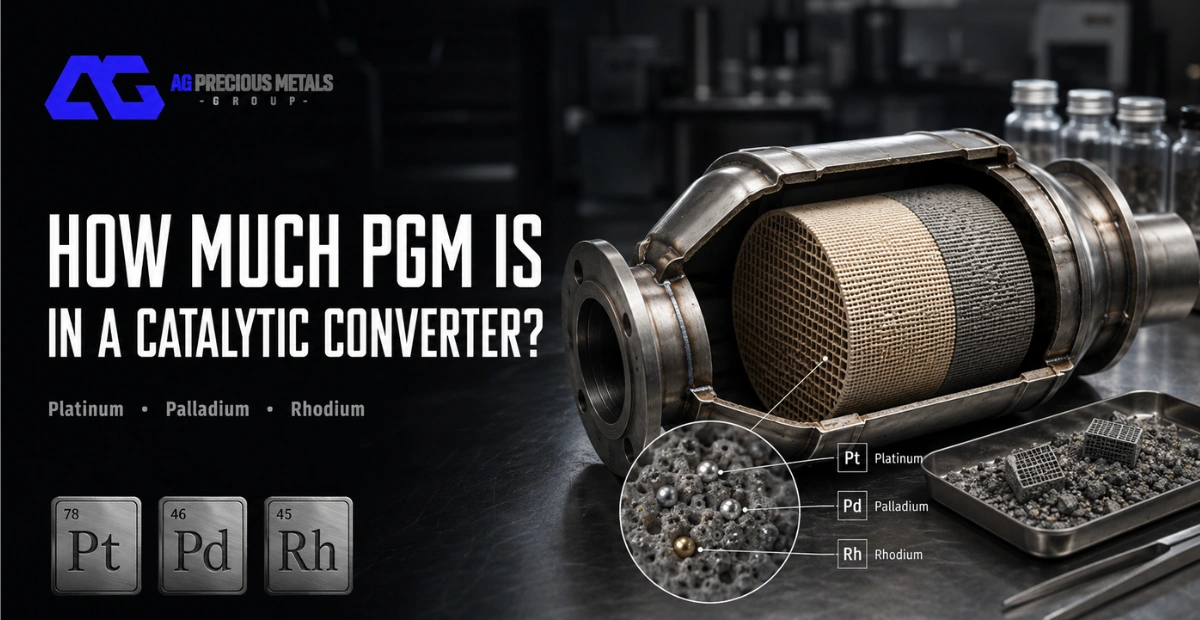
Catalytic converters contain only small quantities of precious metals, yet those metals can represent a significant part of the recycling value of the material. The three platinum group metals most commonly associated with automotive catalytic converters are platinum (Pt), palladium (Pd), and rhodium (Rh).
One of the most common questions in automotive catalyst recycling is: how much platinum, palladium and rhodium is actually inside a catalytic converter?
There is no single number that applies to every converter. Precious-metal loading varies according to vehicle type, engine technology, emission standard, catalyst design, manufacturer, production period, and even the position of the converter within the exhaust system.
For businesses handling used converters, ceramic honeycomb, crushed catalyst, or catalyst powder, understanding this variation is important because theoretical metal content and actual recoverable value are not the same thing.
How Much PGM Is Typically Found in a Catalytic Converter?
Scientific literature shows that the total quantity of platinum group metals in automotive catalysts can vary considerably.
A commonly cited technical range for a typical passenger vehicle is approximately 2 to 6 grams of total PGM. Larger vehicles, SUVs, light trucks, or catalyst systems designed for different emission requirements may contain substantially more, with some published ranges reaching approximately 6 to 30 grams of total PGM.
These figures refer to the combined platinum-group-metal loading rather than a guaranteed amount of platinum, palladium, or rhodium in an individual converter.
This distinction is essential. Two catalytic converters of similar physical size can contain very different precious-metal concentrations.
How Much Platinum Is in a Catalytic Converter?
Platinum has historically been one of the most important catalytic metals used in vehicle emission-control systems.
Its loading depends heavily on the catalyst formulation and vehicle application. Diesel oxidation catalysts have traditionally used significant platinum content, while many gasoline vehicle applications have relied more heavily on palladium.
As a result, it is not accurate to assume that every converter contains a fixed number of grams of platinum.
Factors that can influence platinum loading include:
- Diesel or gasoline engine configuration
- Vehicle model and engine size
- Emission regulations applicable when the vehicle was produced
- Catalyst manufacturer and formulation
- Converter position within the exhaust system
- Use of platinum together with palladium or other catalytic materials
For recycling purposes, the relevant question is therefore not simply whether platinum is present, but how much recoverable platinum exists within the specific catalyst material being evaluated.
How Much Palladium Is in a Catalytic Converter?
Palladium is widely used in modern gasoline catalytic converters and can represent an important portion of the PGM content of automotive catalyst material.
The proportion of palladium relative to platinum has changed over time as vehicle manufacturers have adapted catalyst formulations in response to technical requirements, emission standards, and precious-metal market conditions.
This means that a converter from one vehicle generation may have a very different palladium loading from a visually similar converter produced several years later.
Searching only for a generic “grams of palladium per catalytic converter” figure can therefore be misleading.
Actual palladium content must be considered in the context of the converter type or, for processed bulk catalyst, through representative sampling and assay.
How Much Rhodium Is in a Catalytic Converter?
Rhodium is generally used in smaller quantities than platinum or palladium, but it plays an extremely important role in three-way catalytic systems, particularly in the reduction of nitrogen oxides.
Even relatively small changes in rhodium loading can influence the potential commercial value of certain catalyst materials because rhodium is a highly specialized and historically high-value PGM.
However, rhodium loading also varies significantly by catalyst formulation. It should not be estimated solely from the converter’s physical size, external appearance, or vehicle category.
Why Do PGM Quantities Vary So Much Between Catalytic Converters?
A catalytic converter is not a standardized container filled with a fixed quantity of precious metal.
The PGM particles form part of a carefully engineered catalyst coating applied to a ceramic or metallic substrate. Manufacturers adjust this formulation according to the performance required from the emissions system.
Several factors can change the quantity and ratio of platinum, palladium and rhodium.
1. Vehicle and Engine Type
Gasoline, diesel, hybrid, passenger, commercial and high-performance vehicles can require different catalyst technologies.
2. Emission Standards
As emission regulations change, catalyst systems may be redesigned or additional catalyst units may be introduced.
3. Catalyst Formulation
Manufacturers can alter the balance between platinum, palladium and rhodium while maintaining the required catalytic performance.
4. Vehicle Production Period
Catalyst designs evolve over time. A converter manufactured fifteen years ago should not automatically be compared with a modern unit from the same vehicle segment.
5. Converter Position
Some vehicles contain more than one emissions-control catalyst. Close-coupled catalysts, underfloor converters and additional catalyst units can contain different PGM loadings.
6. Catalyst Size Is Not a Reliable Indicator
A physically larger converter does not necessarily contain more precious metal. Catalyst formulation and PGM concentration are more important than shell dimensions alone.
Where Are the Precious Metals Located Inside the Converter?
The platinum, palladium and rhodium are not normally present as visible chunks of metal.
They are distributed in very small quantities through a catalytic coating applied to the internal substrate. In many automotive converters, this substrate has a ceramic honeycomb structure designed to provide a large surface area while allowing exhaust gases to pass through.
The catalyst coating contains the active materials required for emissions reactions, including platinum-group metals.
You can learn more about the structure and metal types in our guide to precious metals in catalytic converters.
Does a Used Catalytic Converter Still Contain All of Its Original PGM?
Not necessarily.
The original catalyst loading specified during manufacturing does not automatically represent the recoverable PGM content of a used converter many years later.
The condition of the catalyst can be affected by:
- Physical damage to the ceramic substrate
- Loss of catalyst material
- Contamination
- High-temperature exposure
- Oil or fuel-related deposits
- Previous processing or partial removal of the internal material
- Mixing with other converter materials
For this reason, theoretical original loading should not be treated as the final commercial assay of spent material.
Can You Calculate Converter Value From PGM Grams?
PGM content is one of the most important factors influencing catalyst value, but simply multiplying an estimated number of grams by the market price of platinum, palladium or rhodium does not provide a reliable commercial value.
A used catalytic converter contains catalyst-bearing material, not refined investment-grade metal.
Commercial evaluation may also consider:
- Actual recoverable PGM content
- Material form and condition
- Sampling and assay results
- Recovery efficiency
- Processing requirements
- Batch size and consistency
- Commercial and refining terms
- Current PGM market conditions
For a more detailed explanation, see our guide to used catalytic converter value.
Whole Converters and Catalyst Powder Require Different Evaluation Methods
A complete catalytic converter can sometimes be initially reviewed using its identifying characteristics, source information, photographs, quantity, and physical condition.
The situation changes once multiple converters have been decanned, crushed, milled, blended, or prepared as catalyst powder.
At this stage, identifying individual converter models may no longer provide a reliable basis for determining the composition of the overall material.
The commercial batch must instead be evaluated as a bulk material stream.
This is why representative sampling becomes particularly important for crushed automotive catalyst and prepared catalyst powder.
Why Representative Sampling Matters
A laboratory can accurately analyze the sample it receives, but the result is only commercially useful if that sample properly represents the larger batch.
Catalyst powder and crushed ceramic material can contain differences in particle size, coating concentration, moisture, contamination and material distribution.
Representative sampling therefore aims to create a smaller sample whose composition reflects the larger lot as closely as practical.
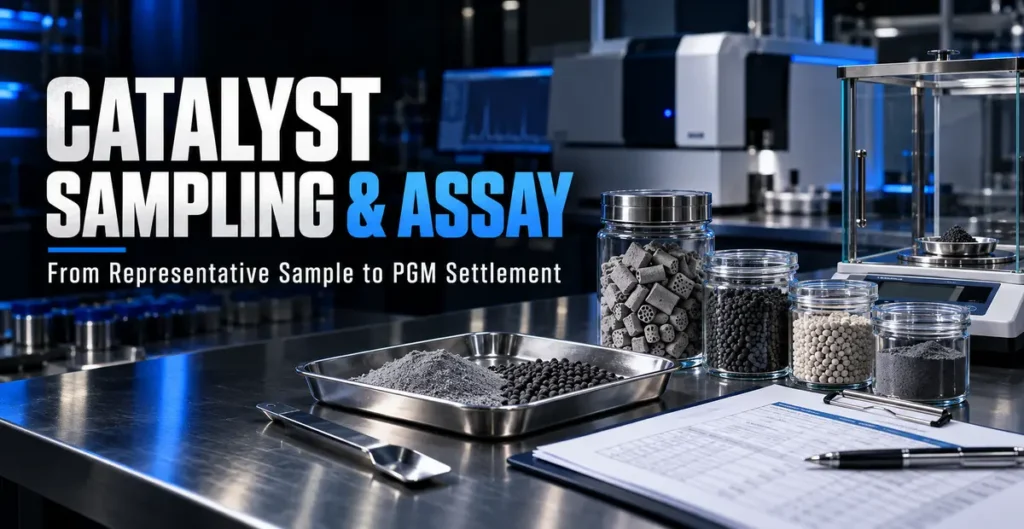
AG Precious Metals Group supports technical evaluation through catalyst sampling and assay for prepared and bulk catalyst materials.
Why Published PGM Figures Should Be Treated as Estimates
Published figures are useful for understanding the general scale of precious-metal loading in automotive catalysts, but they should not be used as guaranteed values for individual converters.
Academic studies themselves report different ranges because the converters being studied may come from different vehicle classes, markets, production periods and catalyst technologies.
In practical recycling, the purpose of these figures is to explain why spent automotive catalysts can be valuable secondary PGM resources—not to replace material-specific evaluation.
How Is PGM Content Determined in a Commercial Catalyst Batch?
The appropriate evaluation route depends on the form of the material.
For prepared catalyst batches, the process may involve:
- Material identification and batch review
- Separation or preparation when required
- Homogenization of bulk catalyst material
- Representative sampling
- Technical assay
- Review of platinum, palladium and rhodium results
- Recovery and commercial settlement planning
This approach creates a stronger technical basis than relying on a generic internet estimate for PGM grams per converter.
Are Catalytic Converters an Important Secondary Source of PGMs?
Yes. Spent automotive catalysts are considered an important secondary source of platinum-group metals.
Scientific studies have repeatedly noted that PGM concentrations in spent automotive catalysts can be significantly higher than concentrations found in primary ores.
This is one reason why responsible automotive catalyst recycling plays an important role in recovering platinum, palladium and rhodium from end-of-life material streams.
Frequently Asked Questions
How many grams of precious metal are in a catalytic converter?
There is no fixed amount. Scientific literature commonly reports total PGM quantities of a few grams for many passenger-vehicle catalytic converters, while larger or different catalyst systems may contain considerably more.
Does every catalytic converter contain platinum?
Not necessarily in the same proportion. Catalyst formulations vary, and some systems rely more heavily on palladium while others may use significant platinum content.
Which precious metal is most valuable in a catalytic converter?
The answer changes with market conditions and the specific catalyst formulation. Platinum, palladium and rhodium can all contribute to the value of automotive catalyst material.
Can you tell PGM content from the size of a catalytic converter?
No. Physical size alone does not reliably indicate platinum, palladium or rhodium loading.
Can a photo show how much PGM is inside a converter?
A photograph can help identify the converter and its physical condition, but it cannot directly measure its precious-metal concentration.
How is PGM content measured in crushed catalyst?
Prepared bulk catalyst typically requires representative sampling followed by appropriate technical analysis. The sample must reflect the larger batch before the assay result can support a commercial decision.
Request an Automotive Catalyst Material Evaluation
If your business handles whole catalytic converters, ceramic honeycomb, crushed automotive catalyst, or catalyst powder, AG Precious Metals Group can review the material information and help determine the appropriate evaluation route.
Provide the approximate quantity, physical form, material source, condition, location, available photographs, and any existing analysis documentation.
Contact AG Precious Metals Group to discuss your catalyst material and the appropriate next step for evaluation, sampling, assay, or PGM recovery.
Join the discussion