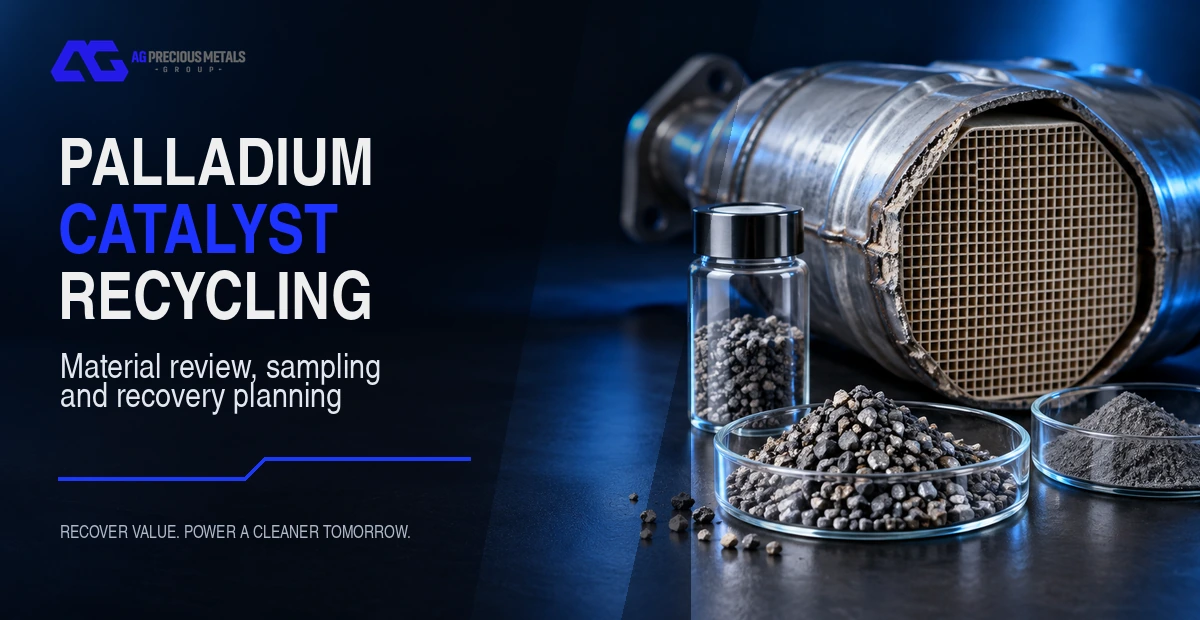
What is palladium-bearing catalyst material?
Palladium is used in several catalyst applications because of its catalytic performance. Automotive exhaust-treatment components are the best-known example, but palladium may also occur in industrial catalyst streams, refining-related residues and process equipment. The presence of palladium cannot be confirmed reliably from appearance alone. The carrier, coating, contamination level, previous use and lot history all affect how the material should be classified.
A useful first split is between intact units, processed ceramic or metallic substrate, fine powders and mixed residues. Intact material needs part identification and controlled handling. Processed material needs particle-size and homogenisation controls. Fine residues require special attention to moisture, dust loss and representative sampling. When a lot contains more than one stream, keeping the streams separate is often more valuable than forcing them into one blended estimate.
AG Precious Metals works with both automotive catalyst recycling and industrial catalyst recycling enquiries. The right route depends on the material itself, not only on the word “catalyst” in a purchase order.
Why market price is only one input
Palladium market price is relevant at settlement, but it is not the same as the payable value of a catalyst lot. Payable value depends on the contained metal determined by an agreed assay, the commercial terms attached to the lot, moisture and treatment considerations, and the documented recovery pathway. A high headline price does not resolve uncertainty about grade, contamination or lot identity.
The practical implication is simple: do not promise a final return before the material has a sampling and assay basis. A transparent workflow distinguishes an indicative discussion from a final settlement. It also makes it easier for the seller to compare offers fairly, because the assumptions behind each offer are visible rather than hidden in a single attractive number.
Information to prepare before an evaluation
- Material origin: the source process, equipment type or vehicle/application history where available.
- Physical form: intact, de-canned, crushed, milled, powder, filter material or mixed residue.
- Lot integrity: whether the batch has been kept separate and how it was stored or transported.
- Approximate weight and condition: including visible moisture, packaging and any foreign material.
- Available documentation: part references, manifests, photographs, prior analyses or chain-of-custody records.
This information does not replace laboratory analysis. It helps the recycler choose a sensible sampling plan and identify issues early. It also prevents a common mistake: treating a heterogeneous collection of material as if it were one uniform commodity.
Sampling and assay: the commercial foundation
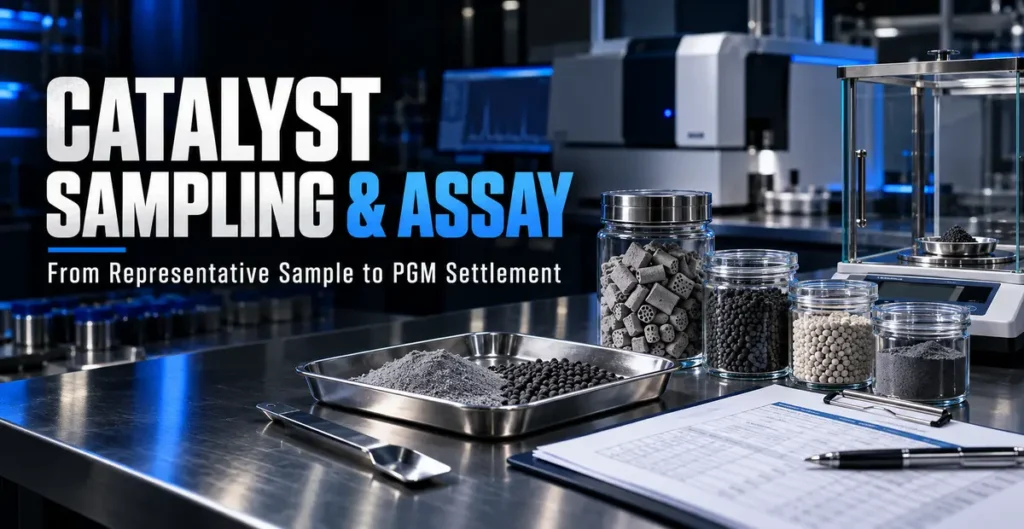
Sampling is where the commercial value of the lot becomes measurable. A sample is useful only when it represents the material that will be settled. For processed catalyst, this typically means managing particle size, mixing, splitting and sample retention. For intact units, the plan may begin with identification, controlled preparation and batch separation before any composite sample is taken.
A robust programme records weights at agreed points, preserves a retained sample when appropriate and documents the handover between parties. The exact method should match the material and commercial agreement. Teams that treat sampling as an administrative afterthought can unintentionally create disputes later, even when everyone acted in good faith.
Read more about sampling and assay before arranging a shipment. The important question is not “Can this lot be tested?” but “Will the selected process produce a representative, auditable basis for settlement?”
How recovery routing is decided
Recovery routing is a technical and commercial decision. The material’s chemistry, physical form, volume, contaminants and available documentation influence the route. Some lots may first require preparation or segregation; others can move directly into an established recovery workflow. A credible recycler explains the decision points without claiming that every catalyst stream has the same yield, timing or treatment requirement.
For business planning, it is useful to ask which milestones will be communicated: receipt, inspection, sampling, assay, settlement and recovery. That structure gives both sides a common operating language. It is also aligned with the broader PGM recovery process, where material accountability must remain visible from intake through final recovery.
A practical intake checklist for buyers and sellers
| Question | Why it matters | Good practice |
|---|---|---|
| Is the material one identifiable lot? | Mixed sources can distort representation. | Label and segregate before dispatch. |
| Is the form known? | Preparation and sampling differ by form. | Share photographs and a concise material description. |
| What is the agreed assay basis? | Settlement needs a common reference. | Confirm sampling, analysis and retained-sample terms in writing. |
| Who records custody and weights? | Traceability protects both parties. | Use handover records and agreed weigh points. |
The checklist is intentionally operational. It helps a commercial conversation become a controlled transaction. It is especially useful when several collectors, yards or plants contribute material to the same programme.
Common mistakes that reduce clarity
- Blending different catalyst types before they have been identified or recorded.
- Relying on a visual estimate, catalogue reference or market price as a substitute for representative assay.
- Shipping wet, damaged or poorly labelled material without describing the condition.
- Leaving settlement terms, sample retention or treatment assumptions unresolved until after receipt.
- Using a generic recycling route without checking whether the lot is automotive, industrial or a mixed residue stream.
Avoiding these issues does not make a complex lot simple. It makes uncertainty visible early, where it can be managed commercially and technically rather than argued about after processing.
When to request a technical discussion
Request a technical discussion when the material is unusual, mixed, heavily contaminated, lacks history or represents a large commitment. A short pre-shipment review can establish what photographs, part lists, weights, sample protocol or packaging information will be needed. It can also identify whether the lot should be separated into several campaigns rather than handled as one.)
Frequently asked questions
Can palladium content be confirmed by looking at a catalyst?
No. Appearance, size and part references can support initial classification, but they do not replace a representative sampling and assay process.
Is a market quote enough to calculate final value?
No. Final value depends on contained metal, agreed assay, payable terms, material condition and the agreed recovery route.
Should mixed catalyst materials be blended?
Not automatically. Segregation usually improves traceability and may improve the quality of the evaluation.
What should accompany a catalyst shipment?
At minimum, clear labelling, lot description, weights, origin information where available and the documents agreed with the recycler.
Next step
If you are preparing a palladium-bearing catalyst lot, contact AG Precious Metals with the material form, approximate quantity and available documentation. A structured review before dispatch helps establish the appropriate recycling, sampling and recovery plan.
Join the discussion