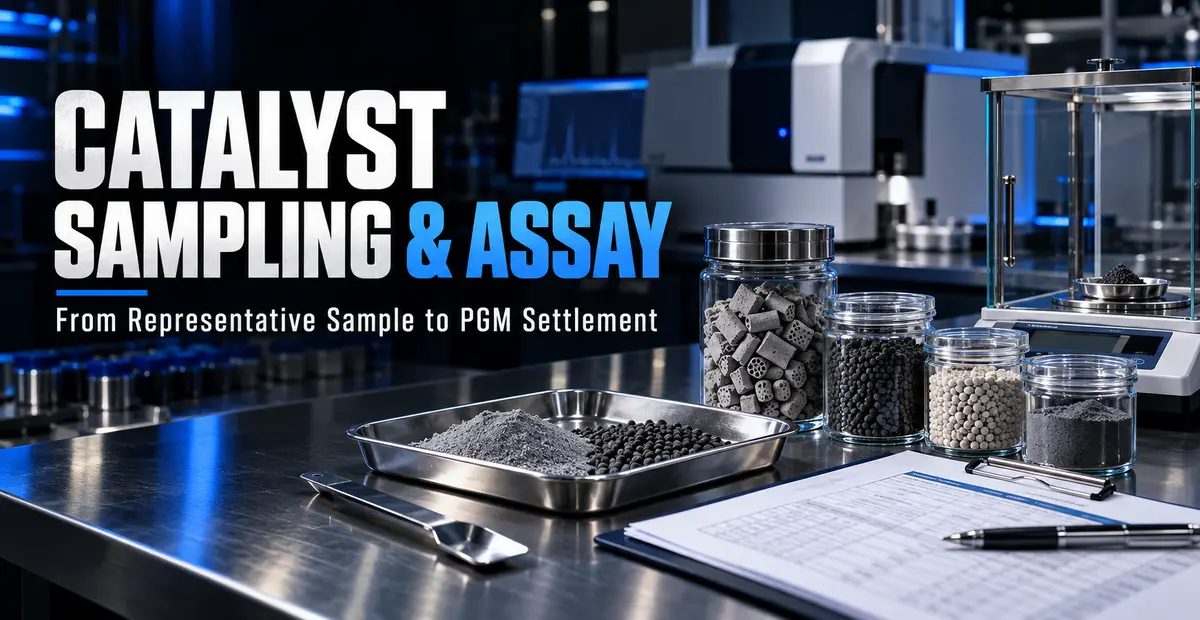
This guide explains how representative sampling and assay support commercial settlement, which details should be documented before evaluation, and why different material forms require different preparation routes. It is intended for businesses handling automotive catalyst, industrial catalyst, refinery or petrochemical catalyst, powders, fines, residues and other PGM-bearing streams.
What do sampling and assay mean in catalyst recycling?
Sampling is the process of selecting and preparing a smaller quantity of material that reflects the composition of the full lot. Assay is the analytical measurement used to identify and quantify the metals present in the prepared sample. In a commercial recovery workflow, the objective is not simply to obtain a laboratory number. The objective is to create a defensible connection between the original lot, the sample sent for analysis and the result used for valuation.
That connection is especially important when a lot is heterogeneous. Whole catalytic converters, separated ceramic honeycomb, crushed monolith, powder, pellets, granules, filter cake and process residues do not behave in the same way during sampling. A review route should therefore begin with the material’s origin, physical form, quantity, condition and degree of uniformity.
Why representativeness matters more than sample size alone
A larger sample is not automatically a representative sample. If valuable particles, fines, moisture or different catalyst grades are unevenly distributed, taking material from only the surface or one container may overstate or understate the true metal content. The sampling plan must account for how the lot is stored, whether it has been mixed, how particle sizes are distributed and whether different material types have been combined.
Three common sources of uncertainty are:
- Lot heterogeneity: different units, grades, process histories or contamination levels are mixed together.
- Particle segregation: coarse and fine fractions separate during transport, handling or storage.
- Preparation loss: dust, fines or material retained in equipment are not controlled or recorded.
A suitable workflow reduces these risks through material classification, controlled preparation, systematic increments, homogenisation and documented sample splitting. The exact route depends on the lot; there is no single sampling method that fits every catalyst stream.
A practical catalyst sampling and assay workflow
1. Define and identify the lot
The parties should first agree on what is included in the lot. Useful information includes the material source, number of packages or units, gross and net weight, physical form, known grades, process history, packaging, photos and any previous analytical documents. Clearly separating unlike materials before evaluation can reduce uncertainty later.
2. Record the received condition
The received condition should be documented before material is processed. Packaging condition, visible contamination, loose fines, foreign metal, moisture and damaged containers can all affect the next step. This record also helps distinguish the original condition of the lot from changes introduced during preparation.
3. Select the preparation route
Whole automotive converters may first require identification and separation of the catalyst-bearing core. Pelletised industrial catalyst, ceramic material, powders and residues may require different size-reduction, drying or blending logic. The purpose is to make the lot sufficiently uniform for representative sample collection without losing or selectively excluding material.
4. Homogenise and take systematic increments
A representative sample is normally built from multiple increments taken across the prepared lot, not from a single convenient point. The increments are combined and mixed so that the analytical sample reflects the overall material. The number and location of increments should be appropriate to the lot size, packaging and variability.
5. Split and secure the sample
After homogenisation, the sample is reduced to manageable portions using a controlled splitting method. Commercial workflows may retain separate portions for the working laboratory, the supplier or client, and an independent check if agreed. Labels, seals, dates and chain-of-custody records should connect every portion to the original lot.
6. Perform the assay
The analytical method should suit the material matrix and the metals being measured. Laboratories may use more than one preparation or instrumental step depending on the catalyst type and required detection range. The report should identify the sample, measured elements, reporting units and relevant method information so the result can be interpreted correctly.
7. Reconcile results and calculate settlement
The assay result is one input to settlement, not the settlement itself. Payable metal, agreed deductions, recovery terms, refining or treatment charges, moisture or weight adjustments, market reference prices and the commercial contract may all affect the final calculation. These terms should be stated clearly before material is committed whenever possible.
How material form changes the evaluation route
| Material form | Main sampling concern | Useful information before review |
|---|---|---|
| Whole catalytic converters | Mixed unit types and variable core condition | Unit count, source, photos, cut or intact condition |
| Ceramic honeycomb or crushed monolith | Breakage, dust and uneven particle size | Net weight, preparation history, packaging and fines |
| Catalyst powder | Segregation, dust loss and moisture | Batch size, container count, storage and handling history |
| Industrial pellets or granules | Different grades, contamination and process history | Plant or process source, SDS, grade, quantity and condition |
| Filter cake, residue or fines | Moisture, variable solids and matrix effects | Origin, moisture information, packaging and available analyses |
AG Precious Metals Group reviews catalyst and PGM-bearing material types by source and physical form before recommending an evaluation route.
Assay accuracy, precision and representativeness are different
These terms are often used interchangeably, but they describe different questions:
- Representativeness: does the sample reflect the complete lot?
- Precision: do repeated measurements of the same prepared sample agree closely?
- Accuracy: how close is the measurement to the accepted or true value under the chosen method?
A laboratory can produce precise repeated results from a sample that does not represent the lot. That is why the preparation and sampling record should be reviewed alongside the assay certificate. When results differ materially between parties, the first question should not automatically be which laboratory is wrong; sample equivalence, moisture basis, units, digestion or preparation route and reporting basis may also need review.
What should be documented before commercial settlement?
A clear transaction record reduces avoidable disputes. Depending on the material and contract, the following items may be relevant:
- lot identity, source and material description;
- gross weight, tare and agreed net weight;
- packaging count and condition on receipt;
- moisture or dry-basis treatment, where applicable;
- preparation, homogenisation and sampling procedure;
- sample labels, seals and custody record;
- assay method, measured metals, units and reporting basis;
- rules for check assays, umpire analysis or result reconciliation;
- payable-metal terms, deductions, fees and price reference;
- timing and method of final settlement.
For a closer look at this stage, see AG’s sampling and assay service and the broader PGM recovery pathway.
Common mistakes that weaken a catalyst valuation
- Combining unlike catalyst grades without recording their proportions.
- Taking a grab sample from the top of a drum, bag or pile.
- Ignoring fines, dust or material retained in packaging.
- Comparing results reported on different moisture or weight bases.
- Using a laboratory result without confirming the sample identity and preparation route.
- Discussing treatment charges and settlement rules only after processing has begun.
- Assuming appearance alone can establish PGM content or commercial value.
Information to send for an initial material review
Before requesting an evaluation, prepare a concise material file with the source industry, material name, physical form, estimated net quantity, number and type of packages, clear photos, known contamination, available SDS or technical documents and previous assay reports. For automotive material, indicate whether the lot consists of whole units, cut shells, loose honeycomb, crushed ceramic or powder. For industrial material, identify the process unit and service history where that information is available.
This information does not replace sampling or assay, but it helps define the right next step. Businesses with a catalyst lot ready for review can contact AG Precious Metals Group and submit the available material details and documents.
Frequently asked questions
Can one laboratory sample represent an entire catalyst lot?
It can only do so when the sample was produced through a suitable, documented process that accounts for the lot’s size, form and variability. The mass of the final laboratory portion alone does not prove representativeness.
Why can two assays return different PGM results?
Differences may arise from non-equivalent samples, segregation, moisture basis, preparation, analytical method, calibration or reporting units. A useful review compares the complete sampling and analytical chain rather than only the final numbers.
Is an XRF reading enough to price a catalyst lot?
The suitable analytical route depends on the material and commercial agreement. A screening result may support identification or preliminary review, but settlement should rely on an agreed method and a representative sample appropriate to the lot.
Should different catalyst materials be mixed before sampling?
Not automatically. Separating materially different grades, sources or physical forms can make preparation and valuation clearer. Any blending should be intentional, documented and compatible with the agreed evaluation route.
What is the most important step before sending material?
Define the lot and share accurate information about its source, form, quantity, packaging and condition. This allows the recycling partner to determine whether the material requires classification, preparation, representative sampling, assay or another review step.
From sample to settlement: build a traceable process
Reliable PGM settlement begins long before the laboratory result is issued. It starts with correct lot identification, controlled preparation and representative sampling, then continues through suitable analysis and transparent commercial terms. Treating the workflow as one traceable system helps both parties understand how the result was produced and how it connects to the final value.
If you have automotive, industrial, petrochemical or refinery catalyst material, review AG’s industrial catalyst recycling solutions or send the lot information through the contact page for an initial technical review.
Join the discussion